
The United Kingdom has its fair share of classic ‘university’ towns of the UK – think Oxbridge, Durham, or St Andrews, in which the institution(s), its faculties and the student body and culture play a large role in the fabric of the place. London, the capital, is arguably the most prominent university city in the UK, not least because it claims more universities than any other city in the country. From UCL and Imperial College London to the London School of Economics, there is no shortage of academic institutions in the ‘Big Smoke’.
Yet, London is not your typical student town, all picturesque cloisters, punting past riverside colleges and studious figures cycling between lectures. London is a heaving metropolis that represents so much more than its numerous universities. As such, it can be an ominous prospect for UK students, and even more so for international students, with the added complexities of linguistic and cultural barriers, a vast megalopolis and innumerable pockets of cultural diversity, superseding what we consider to be typically ‘British’.
Based in London, Hansard Education is a big fan of LDN, both as one of the world’s greatest and most historic capital cities (with roots going back 2000 years, originally named ‘Londinium’ by its Roman founders) but also as a fantastic student destination. However, since it is not geared specifically toward students, there are some caveats around student life in London, not least the cost of living.
Overview
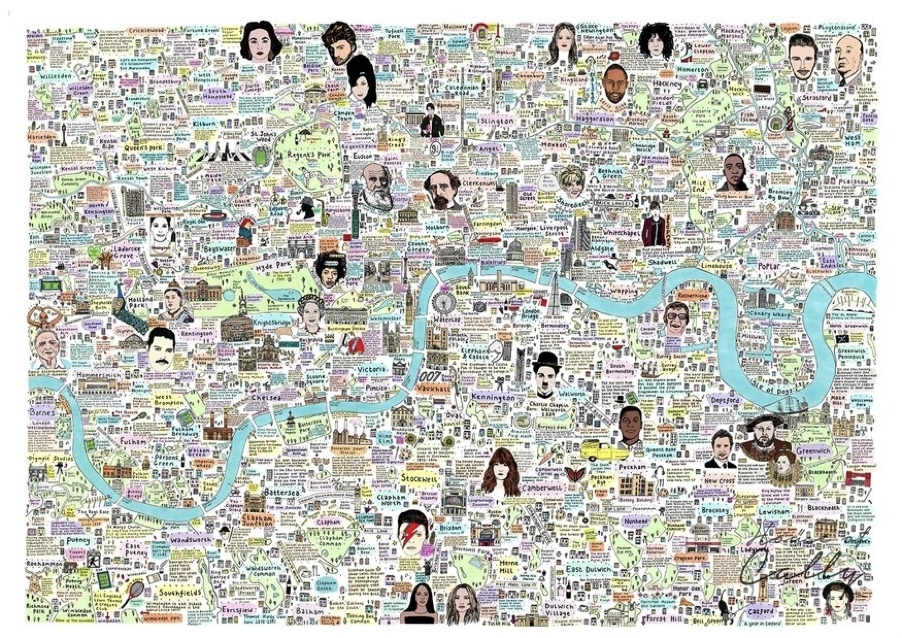
This highly-detailed ‘Map of London History and Culture’, made by House of Cally, does an amazing job of capturing the diversity and multiculturalism of the city and its multitude of areas. The ‘Old Father Thames’ snakes its way through the city and on its banks, you’ll find some of the city’s most notable landmarks, from Battersea Park toward the west, the Houses of Parliament, and the London Eye in central, near the South Bank and Canary Wharf, one of the city’s financial centres in the east.
At a glance, we will try to summarise what the city has to offer (specifically for visiting students) in a few paragraphs:
Central
Central London is the historic heart of the city. It is home to some of London’s most iconic landmarks, such as Buckingham Palace, the Houses of Parliament, and the Tower of London. Central London is also home to several world-class museums and art galleries, such as the British Museum, the National Gallery, and St Paul’s Cathedral. The ‘West End’ is where you’ll find many of the city’s theatres and a great many shops and restaurants around Soho and Mayfair, not to mention the famous Oxford Street. Many of London’s universities can be found in Central: from LSE and London Film School, to Birkbeck and King’s College, to name a few.
North
Often associated with greenery and parks such as Hampstead Heath and Regent’s Park, North London is rather affluent, especially the further north you go, where it is green, peaceful, and rather suburban. On the way north, you will find Bloomsbury, with its air of intellectual intrigue and literary history; there is King’s Cross St Pancras railway station, immortalised in the books of Harry Potter; or Camden Town, a hub of live music and punk energy, where the likes of Amy Winehouse used to hang out. Check out Primrose Hill for a chance to glimpse one of the many celebrities who reside there. London Metropolitan University, Central Saint Martins and University College can be found here.
East
The original home of the Cockney, East London is one of the most diverse parts of the city and offers attractions such as Brick Lane, the Old Naval College in Greenwich, and the Olympic Park in Stratford. Once considered to be a working-class area that did not appeal to tourists, East London has been developed over the last twenty years and is now full of aspirational hipsters and creatives. No longer as cheap as it used to be, it still maintains a unique mix of independent shops, trendy bars and clubs, street art and old school markets like Columbia Road Flower Market and Billingsgate Fish Market. This vibrant part of town is where you will find the University of East London and Queen Mary University of London – both have high proportions of BAME attendees and are often popular with international students.
South
Considered by some to be the ‘up-and-coming’ compass point of London, South is a cultural melting pot that retains some of the originality that East London once had before ‘gentrification’ set in. Around the river is cosmopolitan with plenty of cultural institutions such as the National Theatre, Borough Market and both the Tate Modern and Tate Britain art galleries. Further south and especially in an easterly direction there is a strong Afro-Caribbean legacy since the Windrush generation arrived from the end of the Second World War. As a result, from Brixton to Peckham and all around there is a rich offering of music, food, and art from this part of the world. In some areas, accommodation is decidedly cheaper than in the rest of the city. Here you will find South Bank University, Goldsmiths, and Camberwell College of Arts, to name a few.
West
If there was a ‘posh’ area of London, it would be the west of the city, where adjoining areas such as Kensington, Chelsea and Notting Hill, boast luxurious accommodations for those that can afford them, as well as the sophisticated tastes in cuisine and commerce found along the length of the King’s Road. It is undeniably pretty, with its green spaces, from Hyde Park to Holland Park and Richmond Park if you go a bit further. Other highlights are Portobello Market, the Natural History, Science and Victoria and Albert Museums and the Royal Albert Hall. Further afield is Southall which is fondly called ‘Little India’ due to the buzzing neighbourhood, full of South Asian food and culture. In West London, you will find Imperial College London, the Royal College of Music, and the University of West London.
These are only a taste of what the different parts of London bring to bear, and it is worth noting that the city is hard to define by any standard and is constantly evolving, like any large metropolis. It is a fantastic place to live and study but it can be expensive so if affordability is a factor, you may want to consider a smaller town in the UK or find options that suit your budget. In the second part of this article, we will break down the various aspects of life in London and how to navigate them according to preference and budget.


 +44(0)737 7799 874